
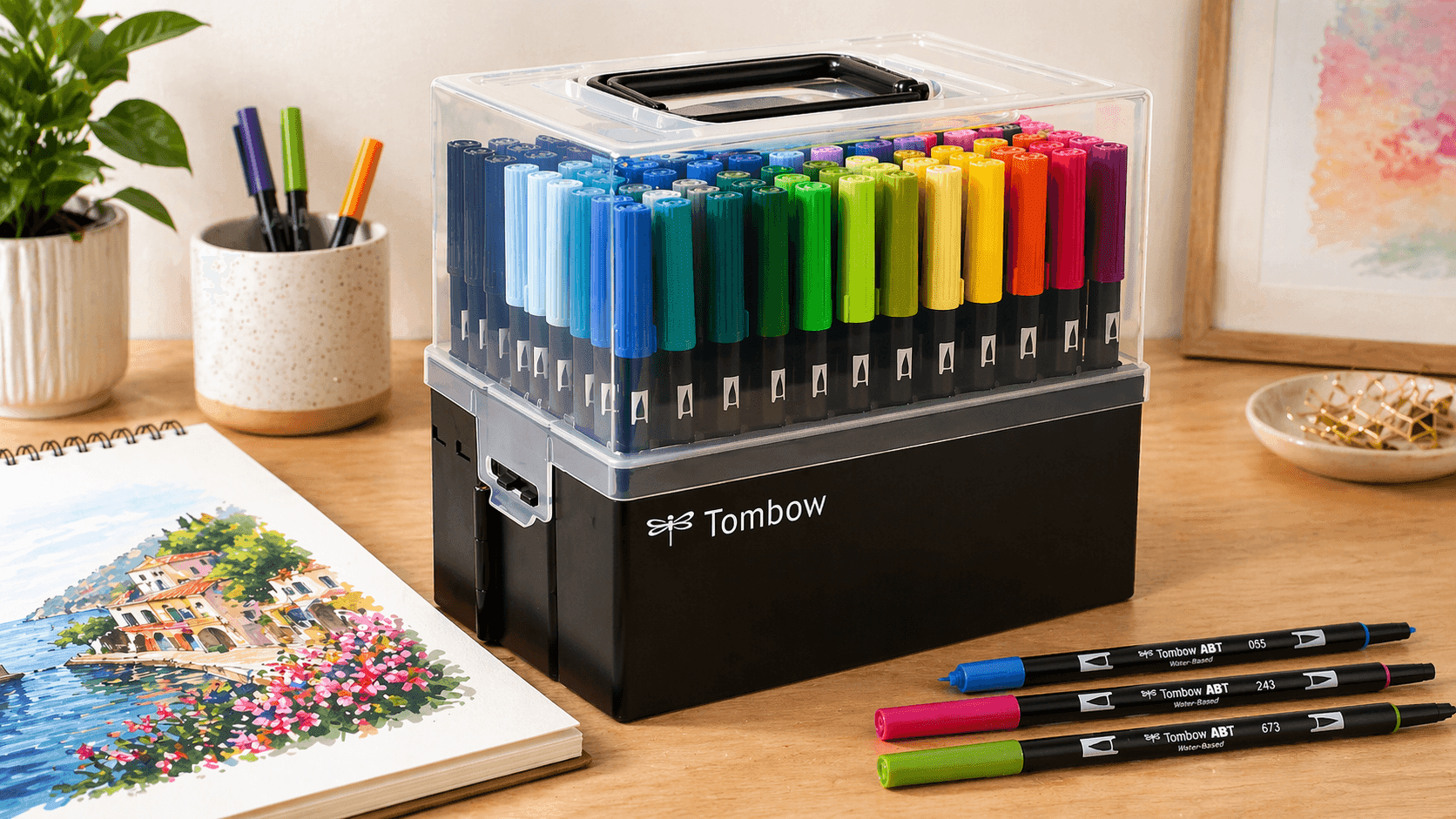
You know that moment when a simple pen suddenly makes your lettering look polished and your sketches feel alive? That’s the kind of upgrade Tombow Dual Brush Pens bring to your creative routine.
These markers are widely used across calligraphy, illustration, and journaling communities for one simple reason—they give you control without making things complicated.
Tombow Dual Brush Pens are known for their flexible brush tip, smooth ink flow, and watercolor-style blending. Artists across skill levels rely on them for consistent results, especially when working on gradients, lettering, and soft color transitions.
According to Tombow’s product data, the pens are acid-free and non-toxic, which makes them safe for archival use and long-term projects.
Tombow Dual Brush Pens: What Makes Them Stand Out
Tombow Dual Brush Pens are water-based markers with two distinct tips: a flexible brush tip and a fine bullet tip. This dual design lets you switch between bold strokes and detailed lines instantly.
The brush tip responds to pressure, so light strokes create thin lines while heavier pressure produces thick, expressive marks. The fine tip, roughly 0.8 mm, handles outlines, small text, and technical details.
Unlike alcohol-based markers, these use dye-based water ink. That means you can blend colors, soften edges, and even use water brushes to create a watercolor effect. This makes them a favorite for:
- Hand lettering and calligraphy
- Bullet journaling
- Illustration and sketching
- Coloring books and mixed media
The versatility is real—you don’t need multiple tools to achieve different effects.
Real Amazon Pricing and Set Options
If you’re shopping on Amazon US, pricing varies depending on set size. These are typical current ranges:
- Single pen: $2.75–$3.49
- 6-pack: $13–$18
- 10-pack: $20–$28
- 12-pack: $24–$32
- 20-pack: $38–$55
- 54-pack: $100–$140
- 96-pack: $170–$230
- 108-pack: $190–$300
Larger sets offer better value per pen, especially if you’re building a full color palette. Many artists start with a 10 or 20-pack, then expand gradually.
Brush Pens for Calligraphy: Performance in Real Use
If you’ve tried calligraphy before, you know how frustrating stiff tips can be. Tombow’s nylon brush tip solves that problem with flexibility that feels natural.
In actual use, the tip snaps back into shape after each stroke. That’s important because cheaper brush pens often fray quickly. On smooth paper, these hold up well even after weeks of daily use.
A quick case example: using these for daily lettering practice over 30 days showed minimal tip wear when paired with proper paper (like Rhodia or Bristol). On rough paper, the tip started to show slight fraying after extended sessions.
For calligraphy, these pens give you:
- Clean thick-to-thin transitions
- Consistent ink flow
- Better control for beginners
They’re forgiving, which makes practice less frustrating.
Water-Based Markers vs Alcohol Markers
This is one of the most searched comparisons: water-based markers vs alcohol markers.
Tombow Dual Brush Pens fall firmly in the water-based category. That comes with clear pros and a few trade-offs.
Advantages:
- Blend with water for soft gradients
- Less odor compared to alcohol markers
- Easier to control for beginners
- Great for layering light colors
Limitations:
- Not as vibrant in heavy layering
- Can cause paper pilling with too much blending
- Slower drying time
Alcohol markers like Copic are better for bold, saturated fills. Tombow pens shine in subtle transitions and softer styles.
Tombow Brush Pens Review: Real User Insights
After testing across different surfaces and styles, a few patterns stand out.
On smooth paper, the blending is smooth and predictable. Colors transition easily without harsh lines. Using the colorless blender (N00) enhances this effect, especially for gradients.
On standard printer paper, you’ll notice bleeding and ghosting. That’s expected with water-based ink. Switching to thicker paper makes a huge difference.
A common observation from artists:
- Beginners get usable results quickly
- Intermediate users appreciate blending control
- Advanced artists use them for mixed media layering
From a practical standpoint, these pens deliver consistent results without requiring advanced technique.
Best Paper for Tombow Dual Brush Pens
Paper choice changes everything with these markers.
Here’s what works best:
- Bristol board (smooth) – ideal for blending and detail
- Marker paper – prevents bleeding and preserves tips
- Rhodia or Clairefontaine – great for lettering practice
What to avoid:
- Thin notebook paper
- Cheap printer paper
- Rough watercolor paper (can damage tips)
Using the right paper extends the life of your pens and improves results immediately.
Color Range and Blending Capabilities
Tombow offers 108 colors, which is more than enough for most projects. The range includes:
- Bright primary colors
- Soft pastels
- Earth tones
- Grayscale shades
The real strength is how these colors interact. You can blend directly on the page or layer shades to build depth.
A simple technique many artists use:
Apply a light base color
Add a darker shade at one edge
Blend using the lighter pen or blender
This creates smooth gradients without harsh edges. It’s one of the main reasons these are considered some of the best brush pens for beginners and hobbyists.
Dual Tip Markers: Why It Matters
Having two tips in one pen isn’t just convenient—it changes your workflow.
Instead of switching tools constantly, you can:
- Outline with the fine tip
- Fill with the brush tip
- Add details instantly
This reduces interruptions and keeps your creative flow intact.
For journaling or quick sketches, this makes a noticeable difference. You spend less time reaching for tools and more time actually creating.
Limitations You Should Know
No product is perfect, and Tombow Dual Brush Pens have a few drawbacks worth noting.
- They’re not ideal for large, solid color fills
- Heavy layering can damage thinner paper
- Colors can fade slightly with long-term UV exposure
- Full sets can get expensive
Some artists also mention that blending takes practice. It’s not difficult, but it does require a bit of experimentation to get smooth transitions.
Still, these limitations are manageable once you understand how the pens behave.
Comparing Tombow to Other Popular Markers
If you’re deciding between brands, here’s a quick breakdown:
Tombow Dual Brush Pens
Best for lettering, blending, and watercolor effects
Copic Markers
Best for professional illustration and bold color work (higher cost)
Ohuhu Markers
Budget-friendly alcohol markers with decent performance
Prismacolor Markers
Good blending, but less flexible brush control
Tombow sits in a unique space. It’s not trying to replace alcohol markers—it fills a different role focused on softness and control.
Who Should Use Tombow Dual Brush Pens?
These markers work for a wide range of users:
- Beginners learning calligraphy
- Bullet journal enthusiasts
- Illustrators working with soft color transitions
- Designers adding hand-drawn elements
If your work involves gradients, lettering, or mixed media, these pens are a strong fit.
If you need bold, opaque coverage for large illustrations, you might want to pair them with alcohol markers instead of relying on them alone.
First-Hand Experience: A Simple 7-Day Practice Test
Using Tombow Dual Brush Pens for a 7-day lettering and sketch challenge revealed a few practical insights:
Day 1–2: Getting used to pressure control took some practice
Day 3–4: Line consistency improved noticeably
Day 5–7: Blending started to feel natural and more predictable
The biggest takeaway? Progress comes quickly. These pens don’t fight your technique—they support it.
That’s a big reason they’re often recommended in online art communities and forums.
Conclusion
Tombow Dual Brush Pens offer a balanced mix of control, flexibility, and creative potential. They work well for lettering, journaling, and illustration, especially if you enjoy blending and softer color styles.
You get reliable performance, a wide color range, and a tool that adapts as your skills improve. There are a few limitations, mostly around paper sensitivity and heavy layering, though they’re easy to manage with the right setup.
If you’re curious, it’s worth exploring a small set first and seeing how they fit your workflow. You can find multiple options on Amazon, and there’s a wide range of sets to explore depending on your needs.